Showing posts with label Atlanta Botanic Garden. Show all posts

Friday, October 20, 2017

Plant-to-Plate Education at the Atlanta Botanical Garden


The Atlanta Botanical Garden has, hands down, the best cooking program of any botanic garden that I have visited.  So many gardens do a great job of showcasing and educating visitors about important food crops, but the Atlanta Botanical Gardens really shines in their plant-to-plate education. 

The Edible Outdoor Kitchen is clearly designed for visitor education.  The kitchen features an extensive island that includes a cooking range with plenty of counter space and a bar for visitors to get a close look at the demonstration.  There is a mirror above the island to allow all the class participants -- even the ones in the back row -- to get a good view of the chef at work. 
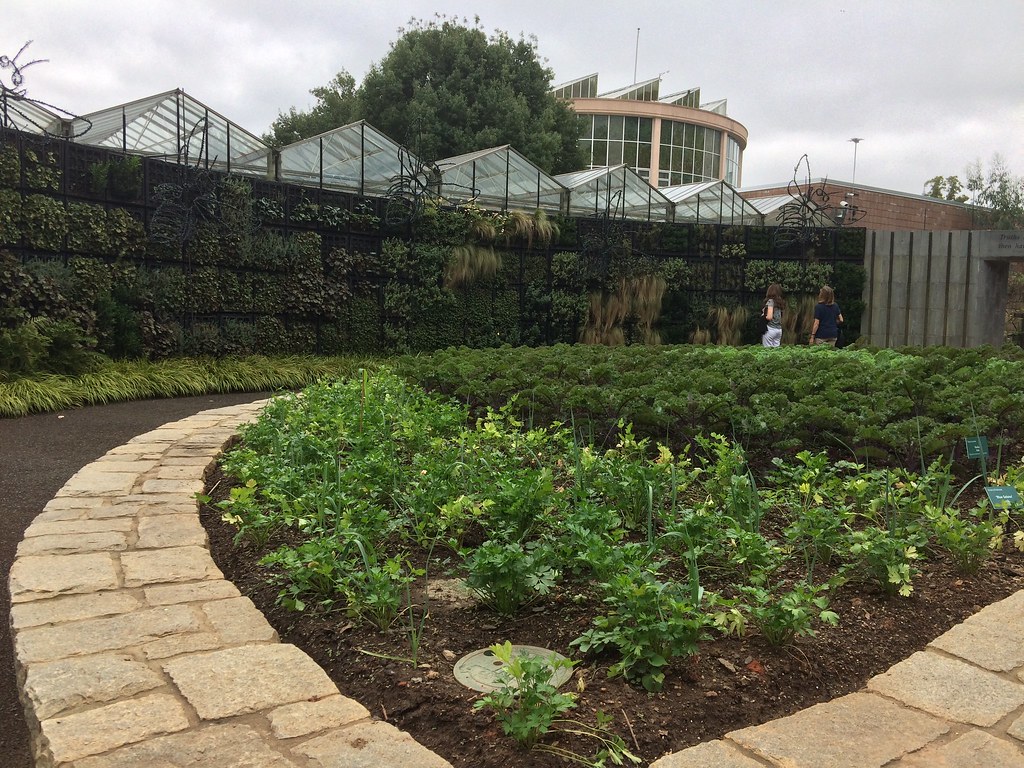
The Edible Garden at the Atlanta Botanical Garden
Visitors can observe the class from a bar next to the island, at several tables under a covered pavilion, or from benches in the back and to the side of the pavilion.  There's also plenty of standing room for folks to pause and listen for a few minutes on their stroll from the Edible Garden to the Fuqua Orchid Center.

The kitchen is located in the Atlanta Botanical Garden's Edible Garden.  The Edible Garden has impressive, large stonework raised beds that showcase plants at the visitor's eye level.  In the center of the first garden room is a water feature that, on past visits, has been used to grow rice.  The first backdrop to the garden are a variety of espalier fruit trees.  The second is an extensive living wall that has herbs and ornamental plants.  There are also formal in-ground plots and a berry patch.

Chef Julia LeRoy is a garden chef
at the Atlanta Botanical Garden
The Atlanta Botanical Garden offers three Garden Chef Demo classes every weekend, free with admission.  The Garden Chefs are tasked with demonstrating a seasonal recipe made with local ingredients for visitors.  In the class I attended, Chef Julia LeRoy prepared a butternut squash salad with seasonal greens, quinoa, onions, apples, roasted walnuts, and dried cranberries.

Class participants didn't simply learn how to prepare the dish -- Chef LeRoy encouraged visitors to consider alternatives to the recipe by asking questions like, "What are some other Georgia apples that are good for baking?"

If I had seen the finished product before attending the class, I might have thought to myself that it was too complicated for me to attempt.  But after Chef LeRoy walked us through the steps, it didn't seem so tricky.  She also gave some tips for alternatives that might be a little easier, like substituting rice for the quinoa or by purchasing roasted walnuts rather than roasting at home. 

The chef also discussed some of her philosophy on cuisine.  "I like to make healthy meals without putting too much thought into it.  I don't need to see the nutritional breakdown," she said, "I just want to enjoy it."  And that kind of gets to the heart of the Garden Chef Demo program.  The Atlanta Botanical Gardens offers these classes to help visitors make the connection that fruits and vegetables can be prepared simply to create delicious, healthy meals.
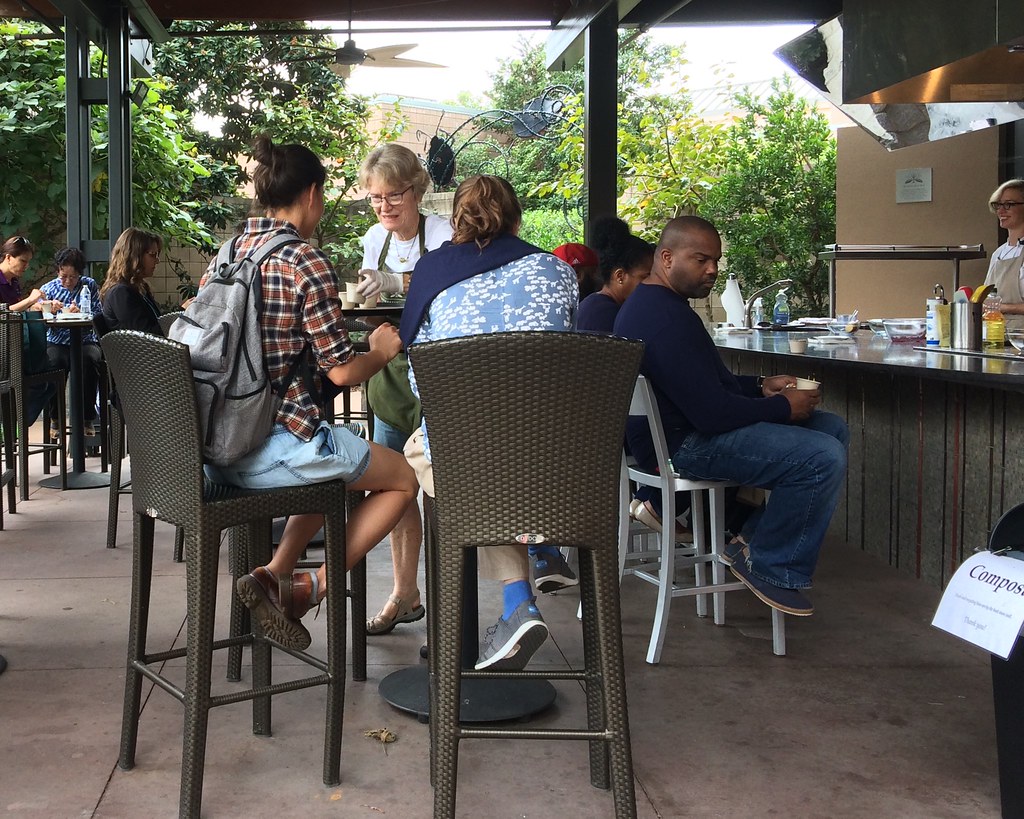
Outdoor Kitchen Assistant gives the class samples
I would imagine that these classes wouldn't be possible without a lot of help.  Two fantastic volunteers were on hand to help set up, greet visitors, assist the chef, serve class participants, and clean up after the class.  These outdoor kitchen assistants did a great job keeping things running smoothly.

In conclusion, if you happen to visit the Atlanta Botanical Garden on a weekend, consider setting aside roughly half an hour.to check out one of these classes.  I've visited a few times where I've been on kind of a tight schedule, and I always kicked myself afterwards for not allowing time to sit in on the class.  The Edible Outdoor Classroom is located at fair distance from the Hardin Visitor Center, Longleaf Restaurant, and other seating areas (besides garden benches), which makes it a good spot for visitors to take a break from exploring the gardens. 

If you only have time to pause for a moment rather than attend a full class, never fear.  The Atlanta Botanical Garden does post all of the class recipes online, so don't stress too much about missing out.  In addition to the recipes from the most recent classes, the website also seems to have the recipe for every dish that has been prepared in the Garden Chef Demos since 2010.  What a great resource!

Other important considerations when planning your trip:
  • Garden Chef Demos:
    • May - October, 12 p.m., 1 p.m. and 2 p.m. Saturdays and Sundays
  • Hours of operation:
    • April - October, 9 a.m. to 7 p.m. Tuesday through Sunday
    • November - March, 9 a.m. to 5 p.m. Tuesday through Sunday
    • Closed Mondays, Thanksgiving, Christmas, and New Years day
    Class participants get to sample the dish prepared
  • *Admission:
    • Adults: $21.95
    • Youth (3-12): $15.95
    • Members and children under 3: Free
  • Parking:
    • 0 - 30 minutes: Free
    • 31 - 60 minutes: $2
    • Additional 30 minutes: $1
    • Daily Maximum: $15
  • Accessibility:
    • Virtually the entire garden is accessible.  I did not note any areas that could not be reached by one way or another.
    • Wheelchairs available at the Visitors Center on a first come first serve basis.
    • Electric mobility scooters may be rented.
  • Pets:
    • Restricted to service animals only.
    • Dogs are allowed for the annual "Reindog Parade" event.
  • Atlanta Botanic's guide to Garden Etiquette is available for review.
*Are you a member of your local public garden?  Ask if membership includes participation in the American Horticulture Society's Reciprocal Admissions Program.  By supporting your local garden, you and one guest could visit the Atlanta Botanical Garden for free.

To see more photos of any of my visits to the Atlanta Botanic Garden, check out my flickr stream.
If you have any questions, ideas, or suggestions, leave a comment or shoot me an email.

 Does your local public garden or garden club offer culinary classes?  What are they like?

When is the last time you attended a cooking class?  What dish did you prepare? 


Sunday, October 15, 2017

Atlanta Botanical Garden, Revisited

Why return to a garden that you've already visited?  There are so many reasons.  Gardens change with the seasons and over time.  Public gardens offer new features and programs to encourage folks to repeat their visits.  I had the opportunity to explore the Atlanta Botanical Gardens twice in 2013, and I wrote all about it at the time. While some things have remained the same, there have been some changes that I believe warrant a new blog post.

"Chalices" was one of the featured pieces for the
Curious Garden at Atlanta Botanical Garden
The exhibit of the season is artist Adam Schwerner's "The Curious Garden".  To me, the most eye-catching feature of the exhibit is called "The Spirited Bosk".  Hundreds of maple saplings were cut at the base of the trunk, all the foliage was removed, and the trees were painted bright shades colors and placed throughout the property.  In addition to the two areas with painted trees inside the property, a line of pink painted trees greets visitors from the entrance to the garden's parking area.


All-in-all, Schwerner created twelve art features that were scattered throughout the grounds, including green chains in the Fuqua Conservatory that were designed to mimic the aerial roots suspended from Cissus, purple totems along the flower walk, large red accents suspended above the Kendeda Canopy Walk designed to attract visitors' attention to the tree canopy overhead, and a mixture of glass and orchid chandeliers in the orchid center.


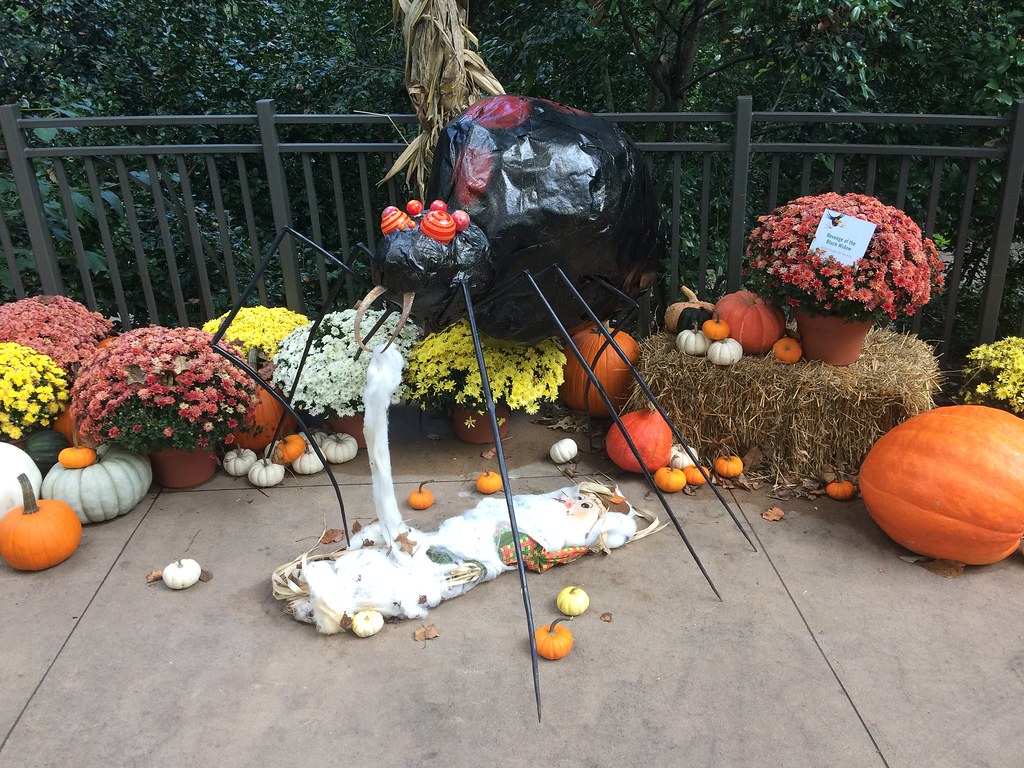
"Revenge of the Black Widow" is part of the
Scarecrows in the Garden autumn display

If incredible garden displays and art exhibits weren't enough to bring a visitor in for a repeat trip, the Atlanta Botanical Garden is also hosting their "Scarecrows in the Garden" fall feature.  Businesses, individuals, non-profit organizations, and clubs created more than 100 very creative scarecrows that have been placed throughout the gardens.  Scarecrow themes range the gamete from incredibly quite to pretty downright creepy.  Visitors of all ages really enjoyed the display, and I saw dozens of folks taking selfies with their favorite scarecrows.  If this idea sounds familiar to you, it's possible that your local public garden has a scarecrow fall feature as well.  The next season will bring "Garden Lights, Holiday Nights", which should be a lot of fun for visitors as well.

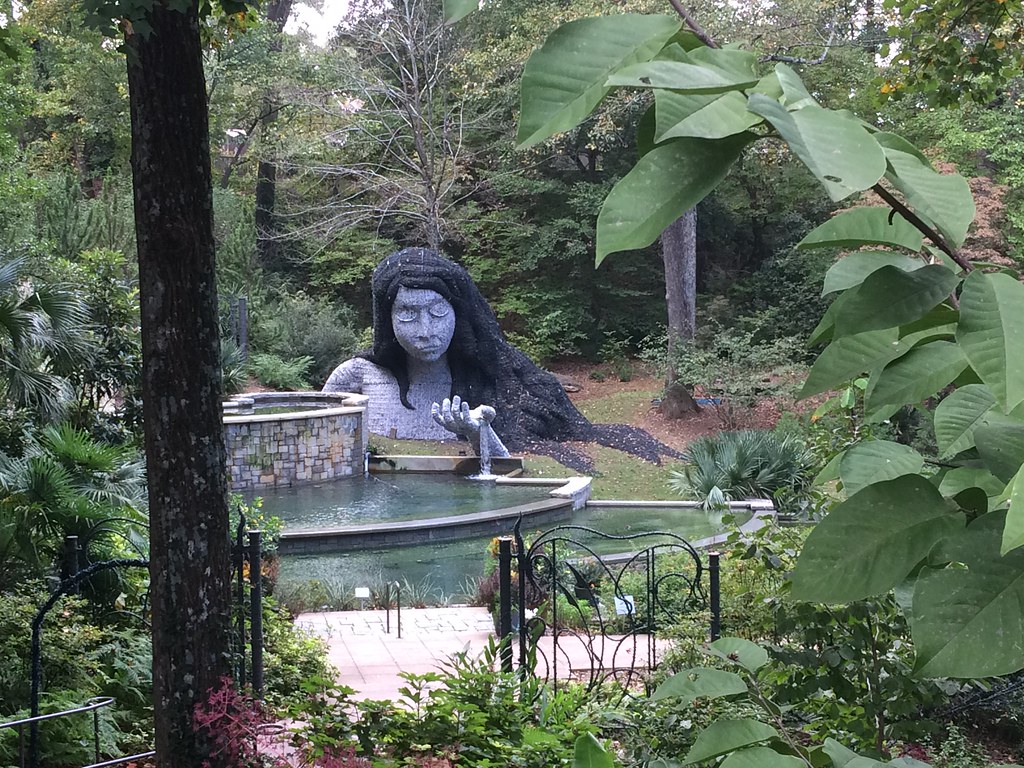
For those of you who read my previous post about the "Imaginary Worlds" exhibit, you will probably remember the really stunning Earth Goddess mosaiculture feature.  I had really been looking forward to returning to see the stunning goddess in all her verdant green, and I had been especially hoping to impress my travel companion with this really cool garden art.  My initial disappointment after discovering that the feature was in the midst of repairs was quickly replaced by excitement.  Right now is a great time to see the "bones" of a mosaiculture art piece.  The wire mesh was totally exposed and unplanted.  Very cool!

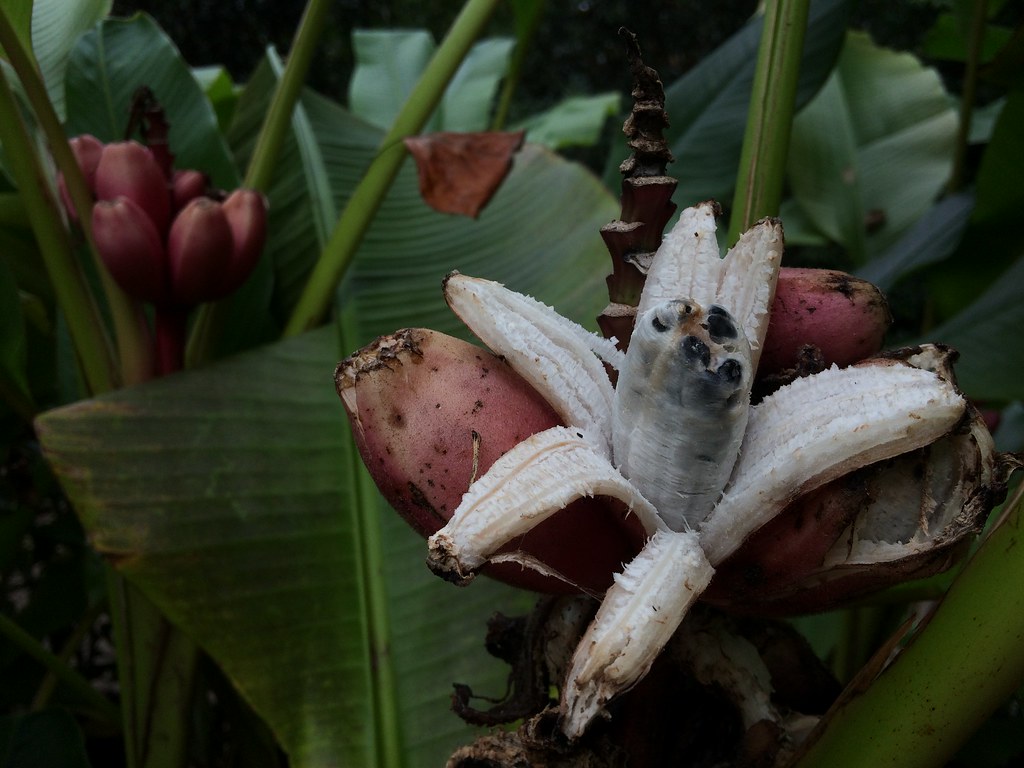
Musa velutina in fruit next to the Cascades Garden
In addition to the seasonal exhibits, visitors should keep their eyes peeled for the Chihuly glass pieces in the gardens and visitor center. Other features include a children's garden, edible garden, conservation native bog garden, Japanese garden, and all of the amazing plants growing across the property.  I was able to catch a cooking class in the edible garden's outdoor kitchen, and I think the experience was worth a standalone blog post.

If you work up an appetite during your trip, be sure to check out the new Longleaf Restaurant for a delicious meal.  If you prefer a quicker meal without the fuss of being served at a table, you can pick up a sandwich or snack at Longleaf's Quick Cafe or out in the garden at the Snack Bar.  The gift shop was also worth a visit, whether you're shopping or window shopping.

Other important considerations when planning your trip:
"Totems" is another feature of the Curious Garden
  • Hours of operation:
    • April - October, 9 a.m. to 7 p.m. Tuesday through Sunday
    • November - March, 9 a.m. to 5 p.m. Tuesday through Sunday
    • Closed Mondays, Thanksgiving, Christmas, and New Years day
  • *Admission:
    • Adults: $21.95
    • Youth (3-12): $15.95
    • Members and children under 3: Free
  • Parking:
    • 0 - 30 minutes: Free
    • 31 - 60 minutes: $2
    • Additional 30 minutes: $1
    • Daily Maximum: $15
  • Accessibility:
    • Virtually the entire garden is accessible.  I did not note any areas that could not be reached by one way or another.
    • Wheelchairs available at the Visitors Center on a first come first serve basis.
    • Electric mobility scooters may be rented.
  • Pets:
    • Restricted to service animals only.
    • Dogs are allowed for the annual "Reindog Parade" event.
  • Atlanta Botanic's guide to Garden Etiquette is available for review.
*Are you a member of your local public garden?  Ask if membership includes participation in the American Horticulture Society's Reciprocal Admissions Program.  By supporting your local garden, you and one guest could visit the Atlanta Botanical Garden for free.

To see more photos of any of my visits to the Atlanta Botanic Garden, check out my flickr stream.
If you have any questions, ideas, or suggestions, leave a comment or shoot me an email.

When is the last time that you visited a botanical garden exhibit?  What was your favorite feature?  

When is the last time that you visited the Atlanta Botanical Garden?  How was your experience?

The Skyline Garden at the Knoxville Botanical Garden
 
The usually verdant mosaiculture "Earth Goddess" is in the midst of repairs

Sunday, May 19, 2013

Explore "Imaginary Worlds" at the Atlanta Botanical Garden

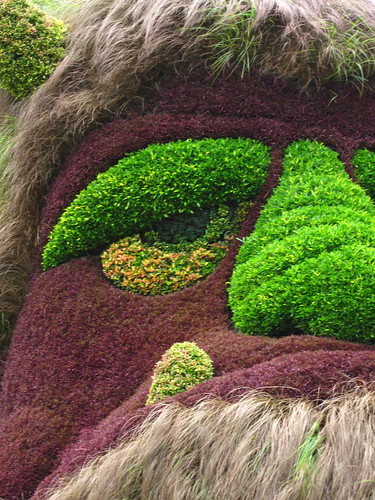
This surly ogre was a favorite in the
Atlanta Botanical Garden "Imaginary
Worlds" mosaiculture exhibit
I absolutely love exploring gardens.  Public gardens, botanical gardens, personal gardens, you name it.  What I love even more than visiting a garden one time, is when there's a reason to return.  It's for this reason that I have been so pleased with the Atlanta Botanical Garden this year.

In February, my cohort Morgan and I headed to Atlanta for the "annual" Southeastern Flower Show.  While planning our trip, we heard that a former classmate, Julie, had landed a job at the Atlanta Botanical Garden.  Julie's tour of the botanical garden turned into the highlight of our visit.  As we were leaving the garden, Julie encouraged us to return in May to check out their upcoming "Imaginary Worlds" mosaiculture sculpture exhibit.  We just got back this afternoon, and I can not wait to tell you all about this wonderful summer feature!

Mosaiculture involves using live plants to create patterns.  Imaginary Worlds takes this a step further by implementing mosaiculture on the face of larger than life statutes.  A steel skeleton provides shape and support for the statute.  The frame is covered with a planting medium, and herbaceous planted as plugs into the medium.  Some of the larger pieces, including (my favorite) "Earth Goddess", are actually supported with heavy duty beams and footers.

Water is crucial to the success of these living statutes.  Without the drip irrigation system that runs in the body of the statute near the plants' root zones, the plants would languish in Atlanta's summer heat.

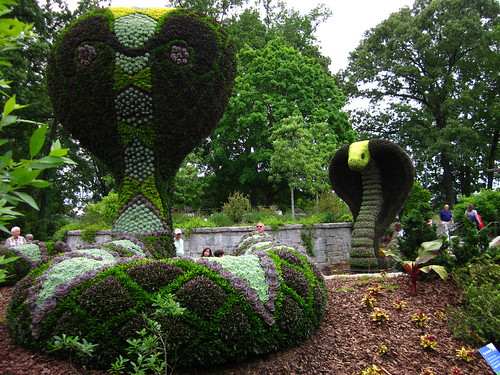
Massive cobras needed extra support in the Atlanta
Botanical Garden "Imaginary Worlds" exhibit
The exhibit seemed to draw visitors of all ages, but the statutes seemed to be especially enchanting with the youngest visitors.  Little girls felt like princesses next to the grazing unicorn and boys leaped over garden beds to get a closer look at the grumpy ogre.  A visit to the Atlanta Botanical Gardens is a must for anyone driving through the city with youngsters this summer.

Of course, the Atlanta Botanical Gardens have more captivating features other than "Imaginary Worlds" that can be experienced throughout the year.  If it's been several years since your last visit, you'll want to experience the Kendeda Canopy Walk.  Since 2010, this is a very sturdy suspension bridge has allowed visitors to walk through the tree tops of Storza Woods.  It's fun to see the garden beds below from a birds eye view.

If the weather is a little cold or drizzly, the Dorothy Chapman Fuqua Conservatory has many mature tropical specimens.  Grape ivy (Cissus rhombifolia) creeps along the conservatory ceiling, and the roots stretch all the way down to the floor.  Live quail help control insect populations in the conservatory (watch your step for little chicks!).  Sounds of the birds and bugs come together to create a relaxing melody.

Other features include a children's garden, edible garden, conservation native bog garden, Japanese garden, and the list goes on.  Keep your eyes peeled for the Chihuly glass pieces in the gardens and visitor center.  Be sure to visit the MetroFresh cafe to relax, enjoy refreshments, and reflect on your visit.  The gift shop was also worth a visit, whether you're shopping or window shopping.

Other important considerations when planning your trip:
  • Hours of operation:
    • April - October, 9 a.m. to 7 p.m. Tuesday through Sunday
    • November - March, 9 a.m. to 5 p.m. Tuesday through Sunday
    • Closed Mondays, Thanksgiving, Christmas, and New Years day
  • Admission:
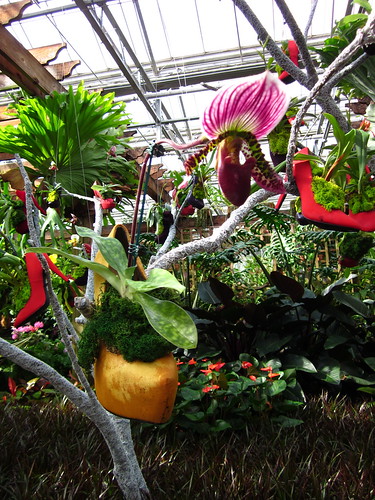
    Lady slipper orchids sit in ladies' slippers
    on stockinged trees in the "Orchid Daze"
    exhibit in the Fuqua Orchid Center
      • Adults: $18.95
      • Youth (3-12): $12.95
      • Members and children under 3: Free
    • Parking:
      • 0 - 30 minutes: Free
      • 31 - 60 minutes: $2
      • Additional 30 minutes: $1
      • Daily Maximum: $15
    • Accessibility:
      • Virtually the entire garden is accessible.  I did not note any areas that could not be reached by one way or another.
      • Wheelchairs available at the Visitors Center on a first come first serve basis.
      • Electric mobility scooters may be rented.
    • Pets:
      • Restricted to service animals only.
      • Dogs are allowed for the annual "Reindog Parade" event.
    • Atlanta Botanic's guide to Garden Etiquette is available for review.
    Atlanta Botanic staff member Julie has a wonderful photo blog - Petal, Thought, Leaf - that catalogues her experiences in the garden.  I follow her, and you should too.  Special thanks to Julie for her brand of Southern hospitality and Morgan for her company!

    To see more photos of my visit to the Atlanta Botanic Garden, check out my flickr stream.

    If you have any questions, ideas, or suggestions, leave a comment or shoot me an email.

    When is the last time that you visited a botanical garden exhibit?  What was your favorite feature?  

    When is the last time that you visited the Atlanta Botanical Garden?  How was your experience?

    "Earth Goddess" was my absolute fav mosaiculture piece in the Atlanta Botanical Garden "Imaginary Worlds" exhibit
    There's plenty to see and do at the Atlanta Botanical Garden in any season